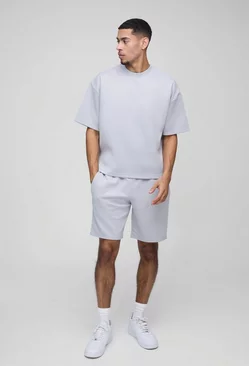
An oversized t-shirt fit comes from four measurements working together: a wider chest, a dropped shoulder seam that sits below the natural shoulder, a body length that stays proportional to that width, and a sleeve that ends around the elbow rather than mid-bicep. Getting just one of these wrong is what makes a tee look like a regular shirt in the wrong size instead of an intentional oversized cut. The fabric weight then decides whether that shape hangs cleanly or collapses.
This guide walks through each measurement, explains how they affect one another, and shows how to check them properly when your first sample arrives.
Why “Just Size Up” Does Not Create an Oversized Fit
Many new brands start by taking a regular-fit tee and grading it up a size or two. The result is usually disappointing: the shirt becomes longer at the same rate it becomes wider, the sleeves get too long, and the neckline opens up. A true oversized pattern changes the proportions, not just the scale.
- Width grows more than length: The chest and hem are widened noticeably, while body length increases only modestly.
- The shoulder seam moves: Instead of sitting on the shoulder point, it drops down onto the upper arm.
- The neckline stays controlled: The neck opening should not grow in line with the body, otherwise it looks stretched.
- The sleeve is shaped for the drop: Because the shoulder already extends down the arm, the sleeve itself is cut shorter and often wider.

Chest Width and Hem: Setting the Silhouette
Chest width is the first measurement to decide, because everything else is balanced against it. Measure it flat, just below the armhole, from side seam to side seam. For an oversized style, this measurement is set well above a regular fit so the shirt does not cling to the body.
Next, decide whether the body is straight or boxy. A straight body keeps the hem width close to the chest width, creating a clean rectangular shape that is popular in streetwear. A slightly tapered hem pulls the garment in at the bottom and feels a little more fitted. Whichever you choose, write both the chest and hem widths into your size chart, because a factory cannot guess the intended shape from the chest measurement alone.
Drop Shoulder: How Far Is Too Far?
The drop shoulder is the detail that most clearly signals “oversized.” Shoulder width is measured from shoulder seam to shoulder seam across the back. In an oversized pattern this measurement is wider than the wearer’s natural shoulders, so the seam falls onto the upper arm.
A deep drop shoulder changes how the sleeve and armhole must be cut. If the shoulder is pushed out without adjusting the armhole depth, the garment pulls under the arm and creates diagonal drag lines. This is why drop shoulder is best developed as a full pattern change rather than a quick edit to an existing block.
Body Length: Keeping the Proportions Balanced
Body length is measured from the highest point of the shoulder (next to the collar) straight down to the hem. In oversized tees, the common mistake is making the shirt too long. When length increases as much as width, the tee starts to look like a dress or a nightshirt, especially on shorter wearers.
Many streetwear brands deliberately keep the body length moderate so that the width does the visual work. Some go further with a boxy, slightly cropped cut. Decide which you want and compare it with a reference garment you already like, rather than choosing a number in isolation.
Sleeve Length, Sleeve Opening and Neck Rib
Because the shoulder seam has already moved down the arm, the sleeve itself needs to be shorter than on a regular tee. Measure sleeve length from the shoulder seam to the sleeve hem, and also specify the sleeve opening (the width at the hem, measured flat). A wider opening gives the relaxed look; a narrow one can make an oversized body look unbalanced.
The neckline deserves equal attention. A wide body with a thin, loose neck rib quickly looks worn out. Many oversized styles use a slightly wider rib and a neckline that sits close to the base of the neck. Specify neck width, front neck drop and rib width in your tech pack so they do not get graded up with the body.
Fabric Weight: What Holds the Oversized Shape
The same pattern looks very different in different fabrics. Lighter jerseys drape and soften the silhouette, while heavier jerseys hold the boxy shape and keep the shoulders crisp. At P&D Textile, t-shirts are produced in 100% cotton single jersey at 180, 220, 240 and 270 GSM, as well as cotton-elastane, interlock and other options.
For a structured oversized tee, brands often lean towards the heavier end of that range. For a summer drop or a softer, more fluid look, a mid-weight works better. If you are unsure, sample the same pattern in two weights and compare them on a body, not on a hanger. You can see the available styles and fabrics on our oversized t-shirt manufacturer Turkey page, and the same fit logic applies if you later extend the range with an oversized hoodie manufacturer Turkey programme.
Checking the Fit at Sampling
Sampling takes 2–3 weeks and is where proportions are confirmed. When the sample arrives, measure it flat against your size chart first, then try it on a person who matches your base size. Check where the shoulder seam lands, whether the hem sits where you intended, and whether the sleeve ends at the right point on the arm. Take photos from the front, side and back so feedback is precise.
Note every correction in centimetres, not adjectives. “Shorten body length by 2 cm” is actionable; “make it a bit shorter” is not. Once the sample is approved, the sampling fee is deducted from the bulk order, and pre-production samples are free for bulk.

Häufig gestellte Fragen
Can I use my existing regular-fit tee pattern for an oversized style?
You can use it as a reference, but an oversized fit needs its own pattern with a wider chest, dropped shoulder, adjusted armhole and shorter sleeve. Simply grading a regular tee up usually makes it too long and loose at the neck.
What is the minimum order for a custom oversized t-shirt?
Our MOQ starts from 100 pieces per colour per style, which makes it possible for startup brands to test a new fit without a large initial commitment.
Which fabric weight works best for an oversized t-shirt?
It depends on the look you want. Heavier single jersey holds a boxy, structured shape, while lighter weights drape more softly. Sampling the same pattern in two weights is the most reliable way to decide.
How long does it take from sampling to delivery?
Sampling takes 2–3 weeks and bulk production 3–4 weeks, with a total ex-factory lead time of around 6–8 weeks.
An oversized tee that looks intentional is the result of balanced measurements, the right fabric and careful sampling. If you are planning a new fit, working with an experienced Turkish clothing manufacturer helps you get the proportions right before bulk. Send us your reference garment or size chart and we will guide you through sampling.
 German
 English
No responses yet