For most new streetwear and lifestyle brands, the crewneck sweatshirt is the safest first style: it is the simplest to construct, gives the largest clean print area and works in almost every fabric weight. A half-zip adds a more technical, layered look and suits fleece or mid-weight cotton blends, while a collared sweatshirt moves the product towards smart-casual and needs careful collar and placket development. The right choice depends less on trends and more on your customer, your branding method and how many styles your first order can realistically carry.
Below we compare the three silhouettes from a production point of view, so you can decide which one to sample first and how to brief your manufacturer.
The Crewneck: The Workhorse of a Sweatshirt Range
A crewneck is a pullover with a round rib neckline, rib cuffs and a rib hem. Because there is no opening, no hardware and no collar, the pattern is straightforward and the front, back and sleeves stay uninterrupted. That makes it the most flexible canvas for screen print, puff print, embroidery or large back graphics.
Crewnecks also scale easily across fits. The same base pattern can be graded into a regular fit for a minimalist label or opened up with a dropped shoulder and wider body for an oversized streetwear cut. If your collection will be built around artwork, a crewneck lets the graphic do the work.
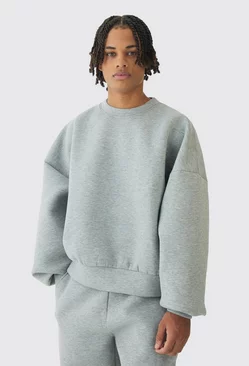
Things to decide when you brief a crewneck:
- Neck rib height and stretch – a taller rib reads more vintage, a narrow rib looks cleaner.
- Shoulder construction – set-in sleeves for a classic shape, dropped shoulders for an oversized look.
- Details – a V-insert under the neckline, side panels or a raw edge can make a basic crewneck feel like your own.
The Half-Zip: Layering, Utility and a Higher Perceived Value
A half-zip (often called a quarter-zip when the opening is shorter) has a zipped placket at the centre front and usually a stand-up collar. Customers read it as more technical and more “outdoor”, which is why it is common in fleece, sherpa and mid-weight cotton blends.
From a manufacturing perspective, the zip adds steps: the placket must be cut and faced, the zip must be chosen (metal, moulded plastic or coil), and the collar must stand properly when zipped up and lie flat when open. These steps take extra sampling attention, so plan at least one round of fit and finish comments specifically for the placket.
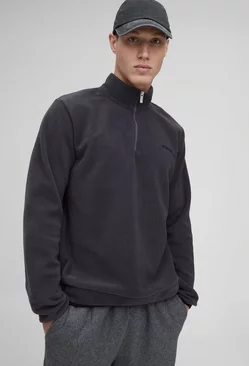
Branding on a half-zip usually moves to smaller placements: a chest embroidery, a woven badge on the sleeve or a zip puller with your logo. A full front print is possible, but the zip splits the upper chest, so artwork must be designed around it.
The Collared Sweatshirt: Bridging Streetwear and Smart-Casual
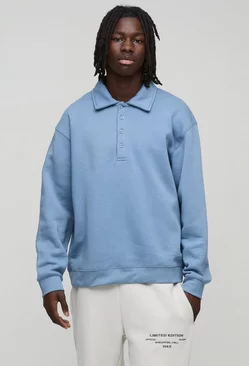
A collared sweatshirt borrows the polo or rugby shirt collar and puts it on a sweatshirt body. It can be finished with a button placket, a short zip or no opening at all. This style appeals to brands that want a slightly more polished product, for example a capsule that sits between a hoodie and a knit polo.
The collar is the critical component. It needs to hold its shape after washing, so the collar fabric (rib, self-fabric or a woven collar) and its interlining should be agreed at sampling stage. Washed finishes such as acid wash can also work on collared styles and give them a more relaxed, vintage character.
Side-by-Side: How the Three Styles Compare
Crewneck
- Simplest construction
- Largest print area
- Works in every fabric weight
- Best for graphic-led drops
Half-zip
- Zip and placket add steps
- Small, premium branding
- Strong in fleece and sherpa
- Layering and outdoor feel
Collared
- Collar shape needs testing
- Chest logo or embroidery
- Smart-casual positioning
- Good for capsule ranges
Matching Fabric to the Style
The silhouette and the fabric should be chosen together. At P&D Textile, sweatshirts are typically made in a 70/30 cotton-polyester 320 GSM fabric with a brushback or loopback inside, available in 15 colours. For a heavier, boxier crewneck there is 100% cotton loopback in 420, 540 and 640 GSM (black and ecru in stock, with overdye and acid wash options). Half-zips work particularly well in polar fleece (220–280 GSM, 30 colours) or sherpa (280 GSM, 10 colours), and 100% polyester 320 GSM is the option when you want a fully printable surface.
As a rule of thumb, very heavy fabrics suit crewnecks best, because a thick placket or collar in 640 GSM can feel stiff. If you want a heavyweight half-zip or collared piece, ask for the placket and collar to be sampled first.
Tip: If budget allows only one sample round, sample the most complex style first (half-zip or collared). A crewneck in the same fabric is usually much easier to approve afterwards.
Building Your First Order: MOQ, Sampling and Lead Time
Because the minimum is set per colour and style, the number of silhouettes in your first drop directly affects the total order. With an MOQ from 100 pieces per colour/style, a launch with one crewneck in two colours is very different from a launch with a crewneck, a half-zip and a collared style in three colours each.
MOQ
100 pcs per colour/style
Sampling
2–3 weeks
Bulk production
3–4 weeks
Ex-factory total
6–8 weeks
The sampling fee is EUR 200 per style plus EUR 40 for UPS, and the EUR 200 is deducted from the bulk order. Pre-production samples are free for bulk orders. Payment is 50% upfront and 50% before shipment. When you develop styles with a printed sweatshirt manufacturer in Istanbul, you can also join video calls during sampling or visit the factory with one week’s notice to check collars, zips and fit in person.
A sensible launch plan for many startup labels is to start with a crewneck in one or two colours, then add a half-zip or collared style in the next drop once sell-through data is available. Brands planning a full range can also coordinate sweatshirts with matching joggers or hoodies from the same Turkish clothing manufacturer to keep colours and fabrics consistent.
Frequently Asked Questions
Which sweatshirt style is cheapest to produce?
In general the crewneck, because it has the fewest components and steps. A half-zip adds a zip and placket, and a collared style adds a collar and often a placket, so both require more labour and trims. Exact costs depend on fabric, quantity and decoration.
Can I use the same fabric for a crewneck and a half-zip?
Yes. Using the same fabric and colour across styles is a common way to build a coordinated drop. Very heavy fabrics may need a lighter facing or collar to keep the placket comfortable, so check this during sampling.
Can a half-zip or collared sweatshirt be oversized?
Yes. Dropped shoulders, a wider body and longer sleeves can be applied to any of the three styles. The collar and zip length should be scaled to the oversized proportions so they do not look too small.
What should I send to start development?
A sketch or reference photo, the fabric and colour you want, a size chart or reference garment, and artwork with placement details. Note any trims such as zip type, buttons or labels so they can be included in the sample.
Conclusion
Crewnecks give you the widest creative and commercial range, half-zips add utility and a premium feel, and collared sweatshirts open the door to smart-casual customers. Choose the style that fits your customer and branding method, sample the most complex piece carefully, and grow the range drop by drop. To discuss your sweatshirt styles, fabrics and MOQ, get in touch with the P&D Textile team.
 English
 German
No responses yet