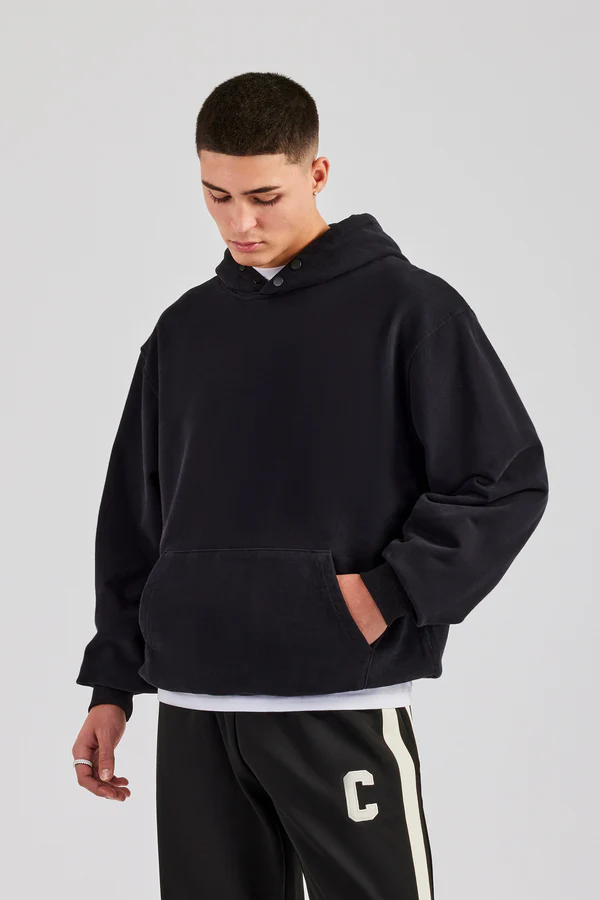
For most new streetwear brands, a pullover hoodie is the better first style: it has fewer components, an uninterrupted front panel for artwork, and fewer things that can go wrong in sampling. A zip-up hoodie is the stronger choice when your customer layers, lives in a milder climate, or when your collection is built around sets and outerwear rather than a single graphic. If you can only afford to develop one style for your first drop, start with the pullover and add the zip-up in the second run using the same fabric and colour.
That is the short answer. The rest of this guide explains the practical differences in construction, decoration, fit and development so you can make the call for your own brand.
The Two Styles at a Glance
Pullover hoodie
- One-piece front panel
- Kangaroo pocket
- No hardware except optional eyelets and cord ends
- Largest clean area for print or embroidery
- Simplest pattern and sewing sequence
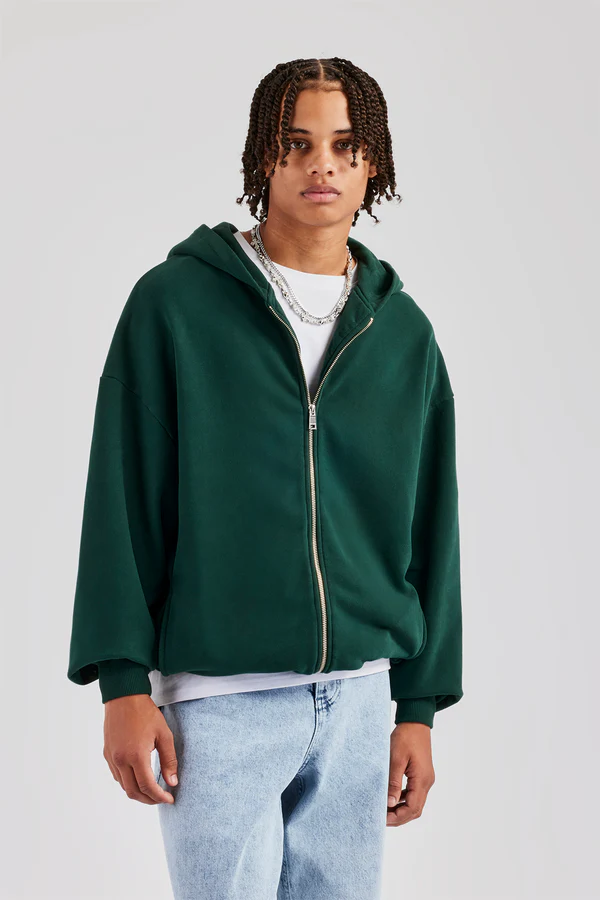
Zip-up hoodie
- Front split into left and right panels
- Two separate pockets
- Zipper, puller and often zipper tape or facing
- Artwork works best on chest, back or sleeves
- Worn open or closed, so it layers easily
Construction: What Actually Changes
On paper the two garments look almost identical. In production they are not. A pullover front is cut as a single piece, the kangaroo pocket is stitched on top, and the body is closed at the side seams. A zip-up front is cut as two mirrored pieces that have to finish at exactly the same length once the zipper is set, because any difference shows immediately at the hem and at the neckline.
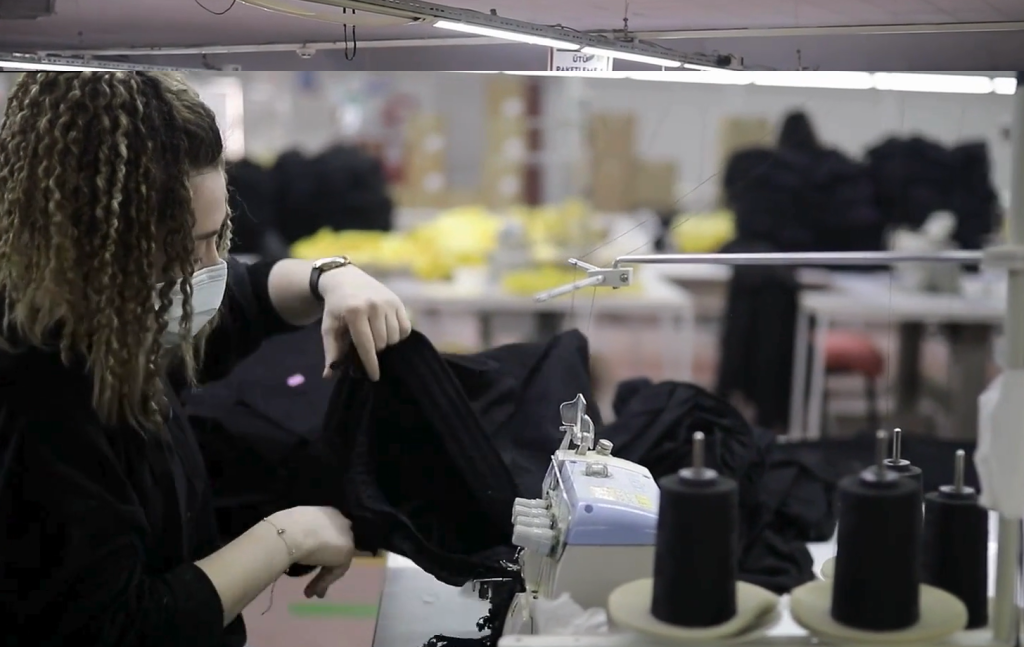
Heavy fleece makes this more demanding. Thick fabric stretches slightly as it passes under the needle while the zipper tape does not, and if the two are not balanced the front edge ripples. This is the “wavy zipper” that buyers notice straight away. It is controlled through pattern work, stabilising tape and careful sewing, and it is the main thing to check on a zip-up sample: lay the garment flat, zip it fully and look along the front edge.
Decoration: Where Your Artwork Can Go
If your brand identity depends on a large front graphic, the pullover wins by default. The whole chest is available and nothing interrupts it. On a zip-up, a centred front design is cut in half by the zipper, and aligning the two halves across a closure is difficult to keep consistent over a full production run.
Zip-ups reward a different approach to placement:
- Left-chest logo in print or embroidery, sized to sit clear of the zipper.
- Large back graphic, which is completely unaffected by the front closure.
- Sleeve or hood details that stay visible when the garment is worn open.
- Branded hardware such as a custom zipper puller, which becomes a design feature in its own right.
All-over prints are a separate case. They are produced on polyester fabric, and P&D Textile offers a 100% polyester 320 GSM fleece that is fully printable, which suits both pullover and zip-up shapes.
Zipper Decisions You Will Need to Make
A zip-up adds a short list of choices that simply do not exist on a pullover. It helps to have answers ready before sampling starts:
- Teeth material: metal reads heavier and more premium; moulded plastic and coil zippers are lighter and quieter.
- One-way or two-way: a two-way zipper opens from the hem as well, which many streetwear customers like on longer, boxier fits.
- Colour: matched to the body fabric for a clean look, or contrast as a deliberate detail.
- How high it runs: stopping at the neckline, or continuing up through the hood.
- Washed finishes: on overdyed or acid-washed garments, the zipper has to be chosen with the wash process in mind, so raise it early.
Tip: When you approve a zip-up sample, test the zipper the way a customer would: one-handed, fast, twenty times in a row. Then wash the sample once and check the front edge again. Problems that appear after the first wash are the ones that generate returns.
Fit, Fabric and Season
Fit behaves differently between the two. A pullover has to pass over the head, so the neck opening and hood are cut with that in mind, and an oversized, dropped-shoulder block feels natural. A zip-up is often worn open, which means the front edges hang freely; very heavy fabric gives a structured, jacket-like drape, while lighter fleece falls closer to the body.
Fabric choice follows from that. P&D Textile’s stock options for hoodies include a 70/30 cotton-polyester 320 GSM in brushback or loopback across 15 colours, an 80/20 460 GSM brushback in black, and 100% cotton heavyweight loopback at 420, 540 and 640 GSM in black and ecru, with overdye and acid wash available. As a general guide, mid-weights are the easiest starting point for a zip-up because they balance well against the zipper, while the heaviest fabrics make a pullover feel substantial and are a natural fit for premium positioning.
Season matters too. A pullover is a cold-weather staple. A zip-up sells across more months because it can be worn open over a t-shirt, which is worth considering if your launch falls in spring or early autumn.
Sampling, Minimums and Planning Both Styles
Each style is developed as its own sample, so launching both at once doubles your development work. At P&D Textile, sampling takes 2-3 weeks and the sampling fee is EUR 200 per style plus EUR 40 UPS shipping; the EUR 200 is deducted from the bulk order. The minimum order is from 100 pieces per colour per style. Bulk production takes 3-4 weeks, and the total ex-factory timeline is 6-8 weeks.
MOQ
100 pcs
per colour / style
Sampling
2-3 weeks
per style
Bulk production
3-4 weeks
after approval
Ex-factory total
6-8 weeks
start to finish
A sensible way to plan is to treat the pullover as your foundation. Approve the fabric, colour and fit on that sample first. When you add the zip-up later, most of the difficult decisions are already made, and the two pieces will sit together as a coherent range. Working with a streetwear hoodie manufacturer Turkey-based brands rely on for both styles also means the same fabric lots and the same pattern block can be used across the pair.
Frequently Asked Questions
Is a zip-up hoodie harder to produce than a pullover?
It has more steps and more components. The front panels must match in length, the zipper has to sit flat on thick fabric, and there are two pockets instead of one. None of this is unusual for an experienced factory, but it does mean there is more to check on the sample.
Can I use the same fabric for both styles?
Yes, and it is usually a good idea. Using one fabric and one colour for a pullover and a zip-up keeps the range consistent and makes it easy to sell them alongside matching joggers.
Do I need separate samples for a pullover and a zip-up?
Yes. They are different patterns, so each is sampled as its own style. The sampling fee applies per style and is deducted from the bulk order for that style.
Which style is better for a brand built on graphics?
The pullover, because the front panel is uninterrupted. If you want a zip-up as well, move the main artwork to the back and keep a small logo on the chest.
Conclusion
Choose the pullover first if you want the simplest development path and the biggest canvas for your design. Choose the zip-up first if layering, versatility and hardware details are central to your brand. Most labels end up with both; the only real question is the order. P&D Textile is a Turkish clothing manufacturer in Istanbul that supports startup brands and low-MOQ projects, with video calls available to talk through your tech pack. Get in touch to start sampling your first style.
 English
 German
No responses yet